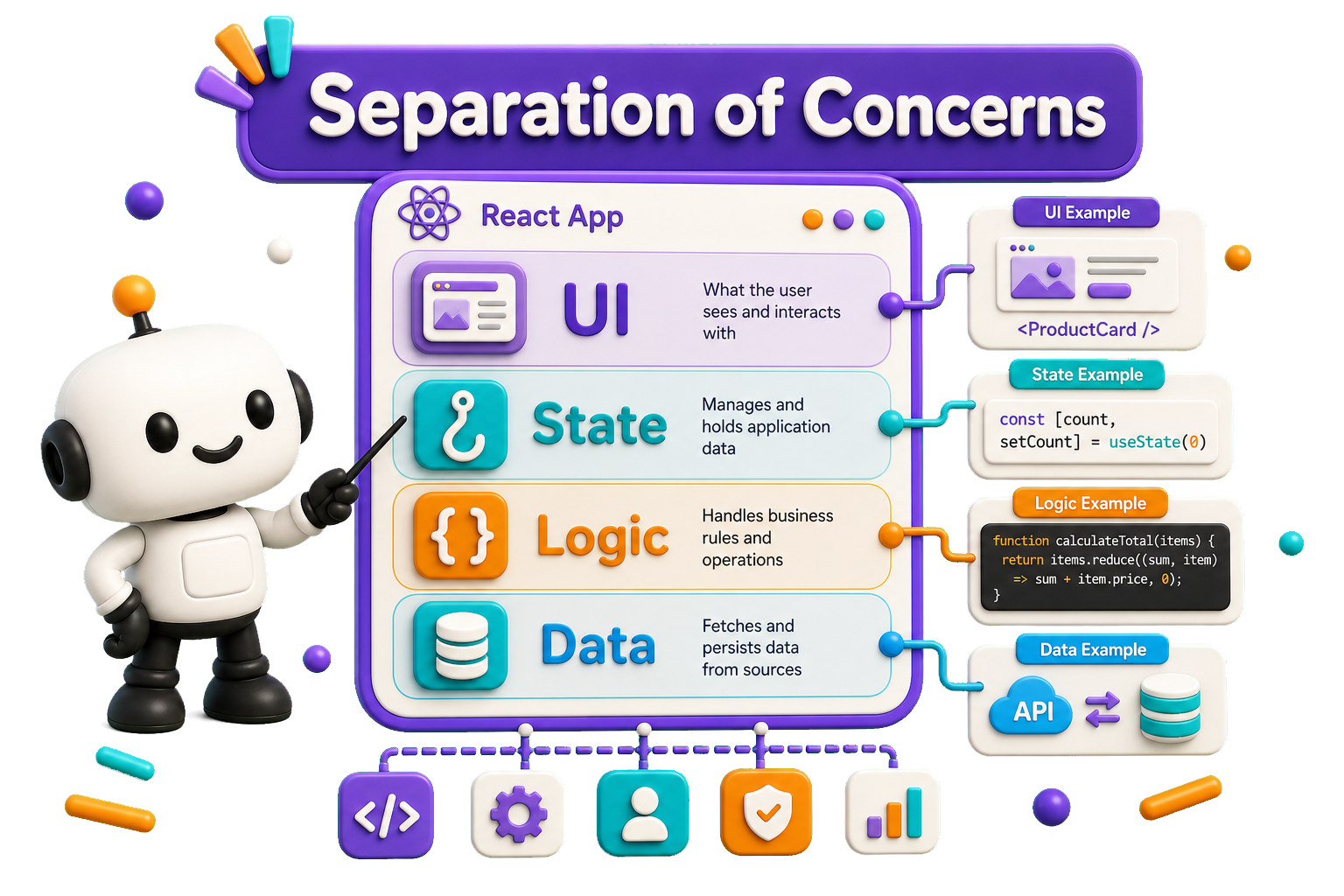
A React codebase becomes easier to maintain when UI rendering, feature logic, and data access are not tightly mixed together. Separation of concerns does not mean forcing everything into layers; it means giving different responsibilities different homes. In beginner projects, it is common to see one component fetch data, transform it, apply business rules, and render markup all in the same file. That works for a short demo, but it becomes hard to test, reuse, and extend.
A better model is:
- UI components focus on rendering and user interaction
- hooks or feature services hold UI-related logic
- repositories or API modules talk to external data sources
This lines up well with DDD because domain concepts can stay visible between the UI and infrastructure. For example, loadProducts can live in a repository while the React hook translates that data into screen state.
Atomic Design still matters here: atoms and molecules should rarely know about data fetching. They are better when they stay focused on presentation and interaction. The main lesson is not "split everything immediately." The lesson is that once a file starts doing several jobs, you should separate those jobs deliberately.
Separation of Concerns in React
One of the most important principles in software architecture is Separation of Concerns (SoC). The idea is simple: each part of an application should have a clear and specific responsibility. When different concerns are mixed together, applications become harder to understand, maintain, test, and scale.
In React applications, Separation of Concerns means dividing responsibilities across different layers instead of placing everything inside a single component. A component that fetches data, stores state, performs business calculations, and renders the user interface quickly becomes difficult to manage. By separating these responsibilities, each layer can evolve independently.
A common approach is to divide an application into four concerns:
UI
The UI layer is responsible for presentation. It renders data and responds to user interactions. UI components should focus on displaying information and delegating actions rather than containing complex business rules.
Examples:
- React components
- Atoms, Molecules, Organisms
- Forms, buttons, labels, layouts
State
The state layer manages the application's current data. It determines what information is available and how it changes over time.
Examples:
- React Context
- useState
- useReducer
- Zustand or Redux
The state layer should not be concerned with how data is displayed.
Logic
The logic layer contains business rules and application behavior. This is where decisions are made.
Examples:
- Validation rules
- Calculations
- Formatting
- Authorization checks
- Workflow decisions
Business logic should be reusable and independent of React whenever possible.
Data
The data layer handles communication with external systems.
Examples:
- REST API calls
- GraphQL requests
- Local storage
- Database access
- Authentication services
The data layer should not contain UI code or business decisions.
Example
Instead of placing everything in a single component:
UserProfile
├── fetches API data
├── stores state
├── validates data
├── calculates values
└── renders UI
Separate the concerns:
UserProfile (UI)
       │
       ▼
UserContext (State)
       │
       ▼
userLogic.ts (Logic)
       │
       ▼
userService.ts (Data)
Each layer has a single responsibility:
- UI displays information.
- State stores information.
- Logic decides what should happen.
- Data retrieves and persists information.
Benefits
Applying Separation of Concerns provides several advantages:
Easier Maintenance
Changes in one area are less likely to affect other parts of the application.
Better Testability
Business rules can be tested independently from React components.
Improved Reusability
Logic and data services can be reused across multiple screens and features.
Clearer Responsibilities
Developers know where functionality belongs, reducing confusion and duplication.
Better Scalability
As teams and applications grow, a well-separated architecture prevents components from becoming overly complex.
Separation of Concerns and Atomic Design
When using Atomic Design, Separation of Concerns can be applied at multiple levels:
Atoms
└── Pure UI

Molecules
└── Compose UI

Organisms
└── Orchestrate UI and interactions

Context / State
└── Manage application state

Services
└── Access external data

Domain Logic
└── Business rules
This creates a predictable architecture where each layer has a clearly defined purpose and developers can reason about the system more effectively.
A good rule of thumb is:
- UI shows data,
- State manages data,
- Logic defines behavior, and
- Data communicates with the outside world.