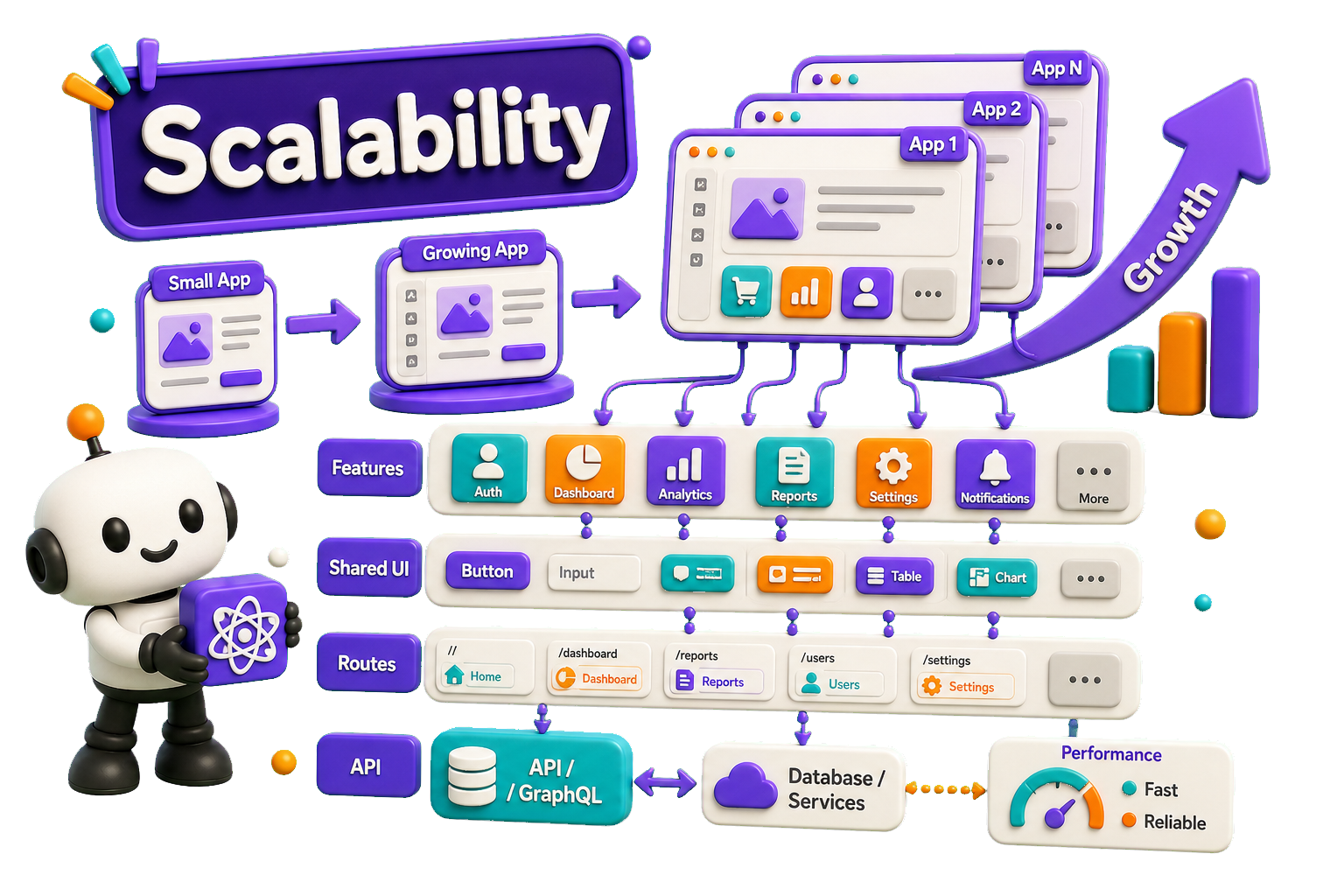
Scalability in front-end development is not only about performance. It is also about whether a codebase can absorb new features, new developers, and new business rules without becoming confusing.
Domain-Driven Design (DDD) is an approach to software architecture that focuses on modeling software around the business domain it serves. Instead of organizing code around technical concerns alone, DDD encourages developers to structure applications around real-world concepts, business processes, and the language used by domain experts.
During this training, DDD will be introduced as a practical method for creating applications that remain understandable and maintainable as they grow in complexity. Participants will learn how to identify domains, subdomains, and bounded contexts, model business concepts in code, and separate domain logic from user interface and infrastructure concerns. By applying DDD principles, development teams can create software that better reflects business requirements, improves collaboration between technical and non-technical stakeholders, and provides a solid foundation for long-term evolution.
Small demos can survive with weak structure. Real applications usually cannot. As more screens, features, and states appear, unclear boundaries start to slow everyone down.
Scalable React projects usually benefit from:
- consistent naming
- stable component boundaries
- predictable data flow
- feature-oriented modules
- a shared design language
Atomic Design supports scalability by making UI composition more consistent. DDD supports scalability by ensuring the code structure reflects the business model rather than only technical convenience.
One useful teaching point is that scalability starts early. You do not wait until the application is large before introducing structure. You introduce enough structure now so growth stays manageable later.
This chapter is a good place to show that React itself is only part of the answer. Long-term maintainability depends on how you organize code, communicate intent, and prevent accidental coupling.
Scalability in Modern Front-End Architecture
Scalability is often associated with handling more users, more data, or higher traffic. In front-end development, however, scalability has a broader meaning. A scalable application is one that can grow in size, complexity, and team ownership without becoming increasingly difficult to understand, maintain, or evolve.
Many applications start small and manageable, but as features are added, requirements change, and development teams expand, architectural weaknesses begin to emerge. Components become tightly coupled, business logic spreads across the codebase, duplication increases, and making changes becomes slower and riskier. Scalability is about preventing this complexity from becoming unmanageable.
A scalable front-end architecture is built on clear boundaries and well-defined responsibilities. Three complementary concepts play an important role in achieving this: Atomic Design, Separation of Concerns (SoC), and Domain-Driven Design (DDD).
Atomic Design provides scalability at the user interface level. By building interfaces from reusable Atoms, Molecules, Organisms, Templates, and Pages, teams can create consistent and maintainable design systems that grow without excessive duplication.
Separation of Concerns provides scalability at the technical level. Responsibilities such as UI rendering, state management, business logic, and data access are separated into dedicated layers. This allows developers to modify one aspect of the application without affecting unrelated parts of the system.
Domain-Driven Design provides scalability at the business level. Features are organized around business capabilities and bounded contexts rather than technical categories. This alignment between software structure and business domains creates clearer ownership, reduces coupling, and enables multiple teams to work independently within their own areas of responsibility.
Together, these approaches create an architecture that scales across three dimensions:
Atomic Design
└── Scales the UI

Separation of Concerns
└── Scales the codebase

Domain-Driven Design
└── Scales the organization
When combined, they provide a foundation for building front-end systems that remain understandable, maintainable, and adaptable as applications, teams, and business requirements continue to grow. Scalability is therefore not simply about handling more users—it is about creating software that can evolve successfully over time.
Domain Approach to Scalability
./src/
└── domains
    └── ServiceDesk
        └── Triage
            ├── api
            ├── components
            │   ├── _types_
            │   ├── atoms
            │   ├── molecules
            │   ├── organisms
            │   ├── pages
            │   └── templates
            ├── events
            ├── helpers
            ├── hooks
            ├── models
            ├── modules
            ├── pages
            ├── services
            └── state
Check Storybook for a practical example of how to structure a domain-oriented front-end architecture. The ServiceDesk/Triage domain contains all the code related to triaging support tickets, including UI components, domain models, API calls, and state management. This structure allows the triage feature to evolve independently while maintaining clear boundaries and a shared language that reflects the business domain.