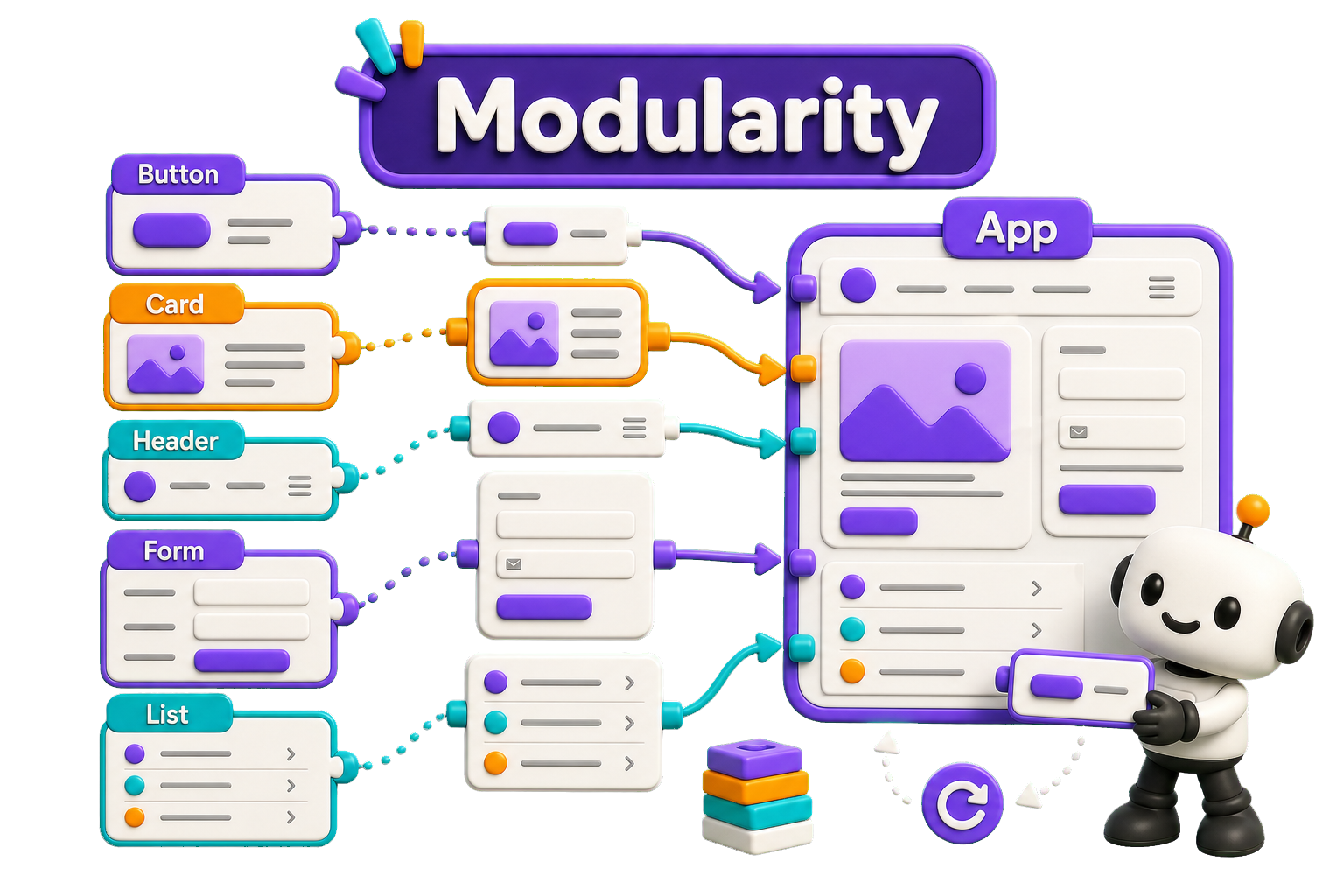
Modularity is about dividing an application into parts that make sense on their own. In React, that usually means grouping related UI, logic, and domain concepts so that a feature can be understood without scanning the whole project. As applications grow, a flat folder full of unrelated files becomes expensive to navigate. Modularity gives structure by grouping code around purpose rather than around accidents of implementation.
A useful beginner-friendly rule is: keep files that change together close together. For example, a catalog feature might include:
- domain definitions such as
Product - UI components such as
ProductCard - hooks such as
useCatalog
This supports DDD because modules can be organized around subdomains or bounded contexts. Instead of one generic components area for everything, you can create meaningful feature modules like catalog, checkout, or customer.
Atomic Design still helps inside each module. A catalog module can contain atoms, molecules, and organisms that serve the catalog domain. In that way, modularity works across features while Atomic Design works within UI composition.
Modularity in Modern React Applications
As front-end applications grow, complexity increases rapidly. New features, additional team members, evolving business requirements, and expanding codebases can quickly turn a well-structured project into a difficult-to-maintain system. Modularity addresses this challenge by organizing software into small, focused, and independent building blocks that can be developed, tested, and evolved in isolation.
At its core, modularity is about creating clear boundaries. Each module should have a well-defined responsibility and expose only the functionality that other parts of the application need. By reducing dependencies between modules, changes become safer, development becomes more predictable, and teams can work more effectively in parallel.
In React applications, modularity is often achieved through a combination of Atomic Design and Separation of Concerns (SoC).
Atomic Design provides a modular structure for the user interface. Small reusable Atoms form Molecules, Molecules form Organisms, and Organisms are assembled into Templates and Pages. Each component has a clear purpose and can be reused throughout the application, reducing duplication and increasing consistency.
Separation of Concerns extends this idea beyond the UI. Instead of mixing presentation, state management, business logic, and data access within the same component, these responsibilities are separated into dedicated layers. UI components focus on rendering, state layers manage application state, business logic contains rules and calculations, and data layers communicate with external systems.
Together, Atomic Design and Separation of Concerns create a highly modular architecture:
UI Components
├── Atoms
├── Molecules
├── Organisms
├── Templates
└── Pages

Application Layers
├── UI
├── State
├── Logic
└── Data
This approach enables developers to reason about the system more easily, encourages reuse, improves testability, and allows applications to scale without becoming increasingly difficult to maintain. Most importantly, modularity creates a foundation where teams can build new functionality with confidence, knowing that each part of the system has a clear responsibility and a well-defined place within the architecture.
Modulair approach
A modular approach to React application architecture emphasizes organizing code into cohesive, self-contained units that encapsulate related functionality. This approach promotes separation of concerns, improves maintainability, and allows for easier scalability as the application grows.
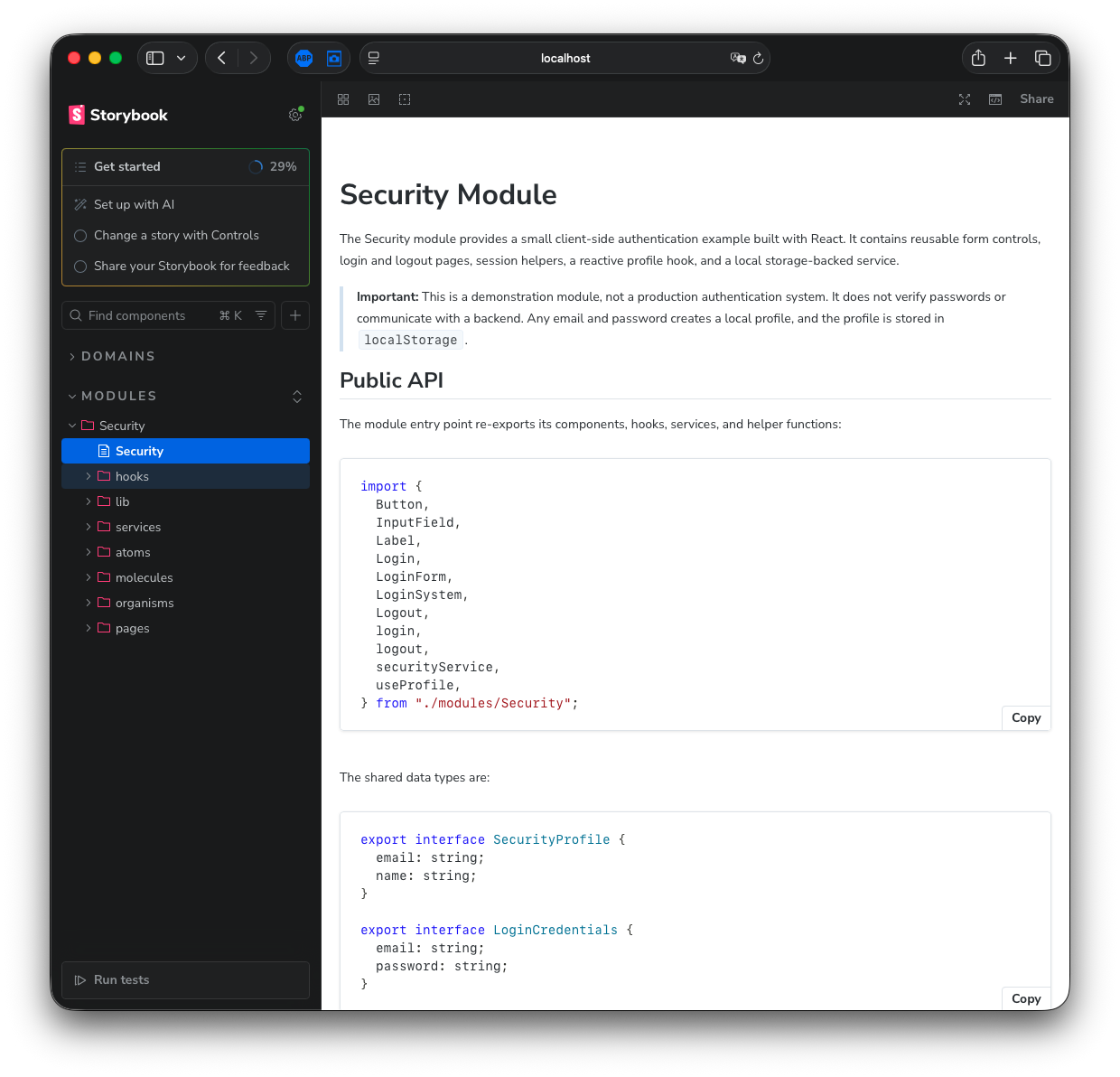
For example, a modular structure for a Security feature might look like this:
src
└── modules
    └── Security
        ├── components
        │   ├── _types_
        │   ├── atoms
        │   │   ├── Button
        │   │   ├── InputField
        │   │   └── Label
        │   ├── molecules
        │   │   └── LoginForm
        │   ├── organisms
        │   │   └── LoginSystem
        │   ├── pages
        │   │   ├── Login
        │   │   └── Logout
        │   └── templates
        ├── hooks
        │   └── useProfile
        ├── lib
        │   ├── login
        │   └── logout
        └── services
            └── securityService
The source structure is organized around the Security feature, with clear separation between UI components, hooks, libraries, and services. Each component is categorized according to Atomic Design principles, while the overall module encapsulates all related functionality for the security domain.