Organisms
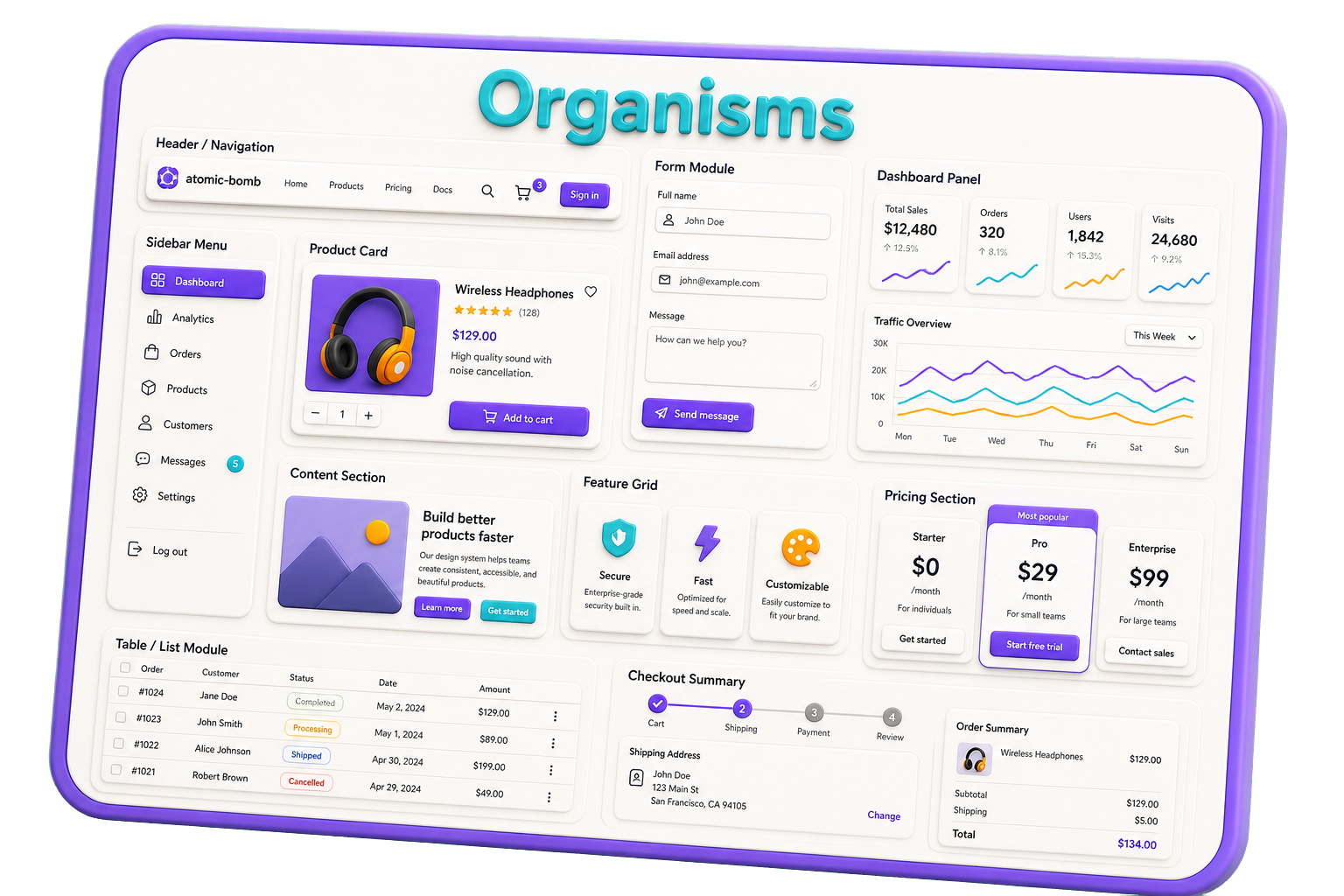
Organisms are larger, self-contained sections of a user interface composed of multiple molecules and atoms working together to deliver a meaningful piece of functionality. They represent distinct areas of a page, such as a navigation bar, product card grid, login form, dashboard widget, or article header.
Unlike molecules, which focus on a single interaction, organisms coordinate multiple interactions and present a complete user-facing feature or section.
Rules for Organisms
- Be composed primarily of molecules and atoms.
- Represent a meaningful section of the user interface.
- May contain presentation and orchestration logic.
- Avoid embedding complex business rules or domain logic.
- Remain reusable across pages and templates where possible.
- Have clear boundaries and responsibilities.
- Expose a well-defined interface through props and events.
- Be independently testable.
Examples
- Header (Logo + Navigation + Search)
- Product List (Product Cards + Filters + Sorting)
- Login Form (Form Fields + Validation + Submit Action)
- User Profile Panel (Avatar + Details + Actions)
- Dashboard Widget (Statistics + Charts + Controls)
Organisms are where individual building blocks start to form recognizable features, creating reusable sections that can be assembled into complete application screens.