Predictive Development with Copilot
Software development is entering a new era. The challenge is no longer how quickly developers can write code, but how consistently organizations can transform architectural decisions into production-ready software. As AI-assisted development becomes mainstream, teams must move beyond using Copilot as a simple code completion tool and start leveraging it as a deterministic engineering partner.
This course explores Predictive Development: a way of working where architecture, standards, patterns, and governance are explicitly defined and then executed through AI-driven workflows. Rather than relying on individual interpretation, teams establish clear engineering rules that enable consistent, repeatable, and scalable software delivery.
Throughout the day, participants learn how to formalize architectural knowledge through SKILLS.md files, reusable engineering skills, functional decomposition, and structured development workflows. The course shows how Copilot can be guided to generate production-ready code that aligns with organizational standards, domain models, and architectural principles.
The course introduces a practical workflow built around:
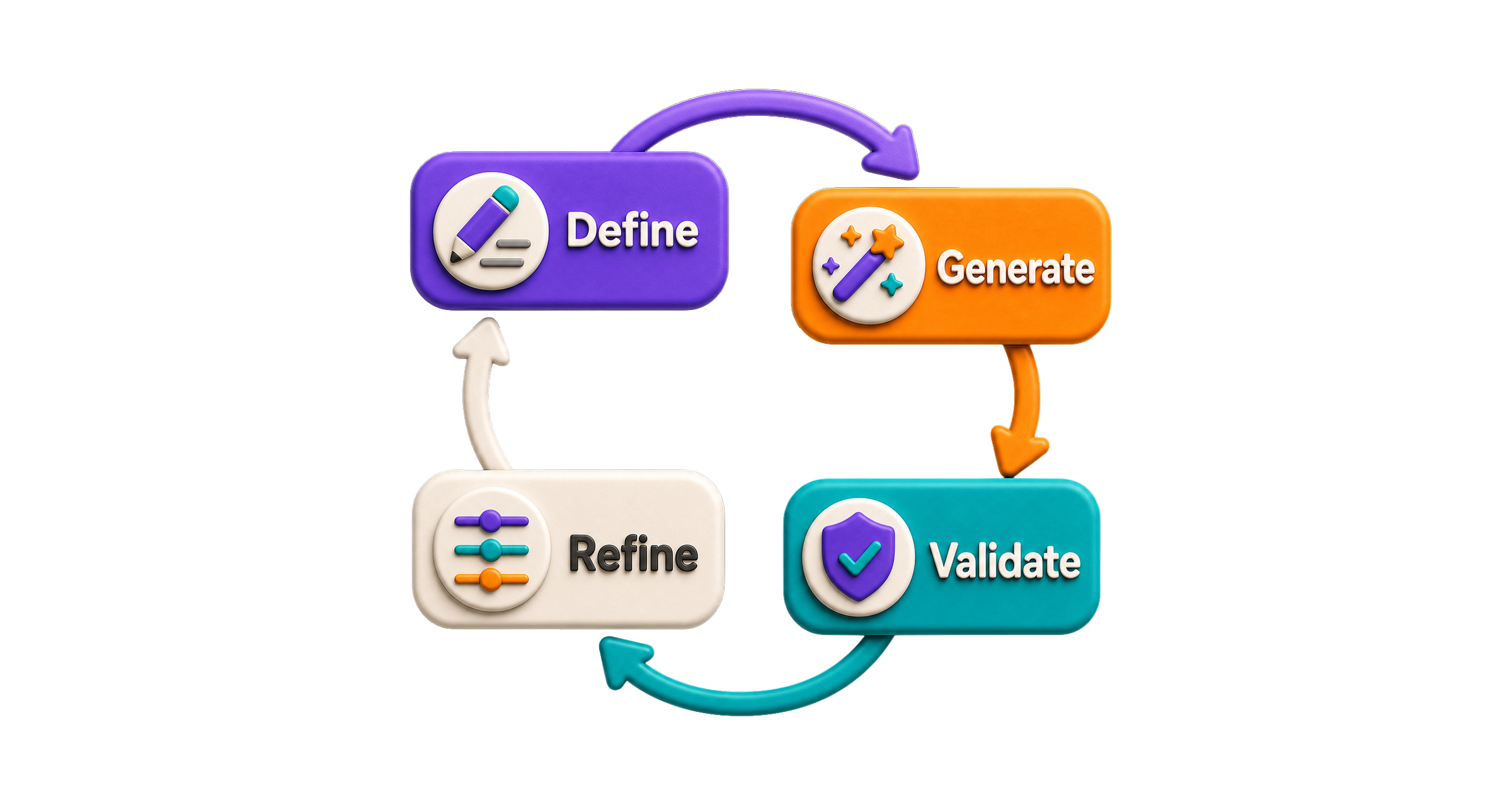
By combining human expertise with AI-assisted execution, development becomes more predictable, maintainable, and scalable. Participants will learn how to feed Copilot the right context, decompose work into implementation-ready issues, validate generated code, and turn lessons learned back into reusable skills.
Chapters
- A New Engineering Partner - Understanding Copilot as an engineering collaborator rather than a code completion tool
- SKILLS.md as a System Interface - Turning architecture, standards, and constraints into executable guidance
- Skill-Driven Development - Using reusable engineering skills to reduce variation and improve consistency
- Predictive Code Generation - Moving from prompt-based generation to predictable, validated output
- MCP - Understanding how tools and context protocols extend AI-assisted engineering
- Define, Generate, Validate, Refine - Applying the core lifecycle for predictable Copilot workflows
- Governance & Scalability - Scaling AI-assisted development safely across teams and organizations
- Skill Building - Building skills from real issues, pull requests, and lessons learned
- Predictive AI vs. Vibecoding - Distinguishing exploratory prompting from production engineering
- Where do Skills Live? - Organizing organization skills, project skills, and runtime instructions
- Skill Factory - Generating structured issues, user stories, and skill references from functional descriptions
Course Schedule
| Time | Topic | Coverage |
|---|---|---|
| 09:30-09:45 | Course framing | Predictive Development, Copilot as an engineering partner, why prompt-and-pray does not scale |
| 09:45-10:30 | Engineering partner mindset | AI as junior developer, human responsibility, context, deterministic workflows, architectural expectations |
| 10:30-10:45 | Break | |
| 10:45-11:30 | SKILLS.md as system interface | Repo instructions, reusable standards, architecture rules, Atomic Bomb, domain-driven front-end guidance |
| 11:30-12:15 | Skill-driven development | Organization skills, project skills, skill composition, skill hierarchy, front-end examples |
| 12:15-13:00 | Lunch | |
| 13:00-13:45 | Predictive code generation | Predictability pyramid, deterministic generation, feature generation, measurement, common failure modes |
| 13:45-14:30 | Define, generate, validate, refine | Functional decomposition, issue files, generated output, validation categories, refinement loops |
| 14:30-14:45 | Break | |
| 14:45-15:30 | MCP, tools, and execution | MCP concepts, engineering tools as capabilities, Atomic Bomb as an MCP tool, agent workflows |
| 15:30-16:15 | Governance and skill building | Governance model, skill lifecycle, branch-per-issue workflow, documentation, skill extraction, feedback loops |
| 16:15-16:45 | Skill factory workshop | Generate ISSUE-n.md files from a functional description, attach SKILLS.md, review issue quality and validation |
| 16:45-17:00 | Wrap-up | Predictive AI vs. vibecoding, implementation checklist, next steps for applying the model in real teams |